


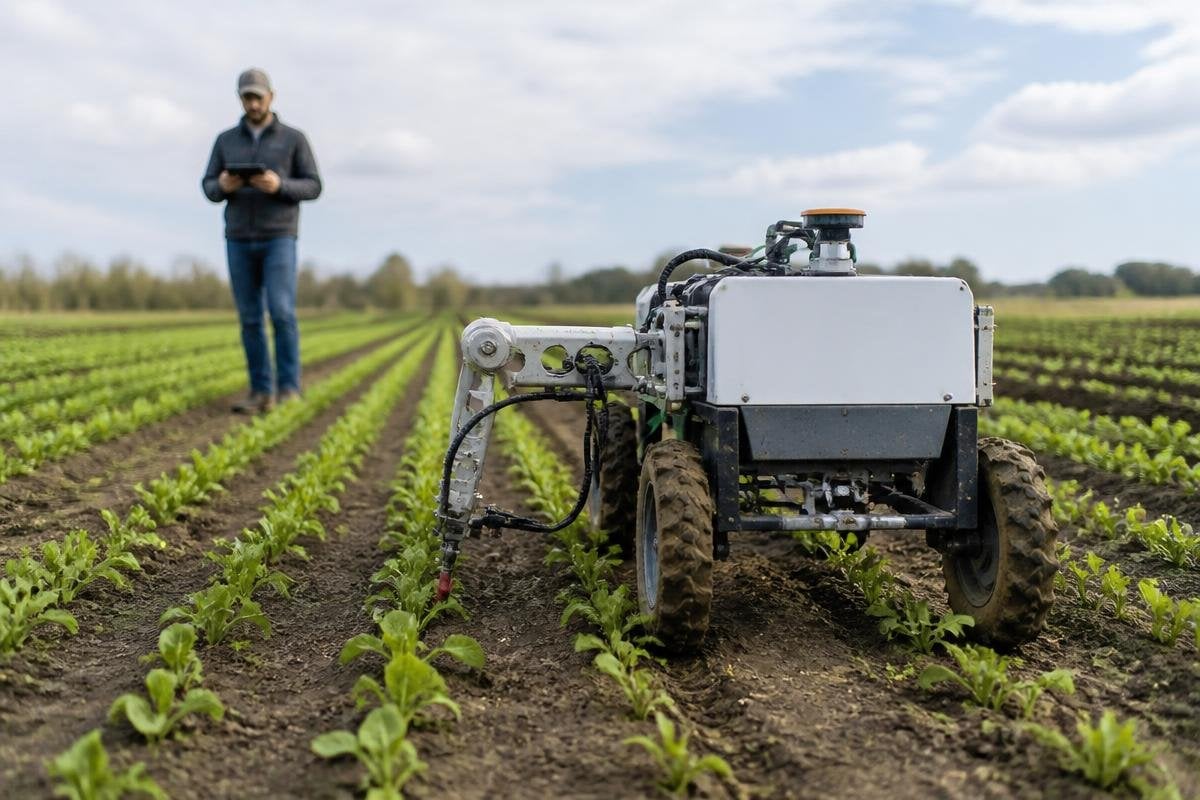
A farm robot could save resources by acting on one plant, row, or animal at a time. That changes the question from how much land a machine can cover to how much water, fuel, and chemical input each task needs.
Quick read
- Camera-guided machines could spot weeds before a full field treatment.
- Electric drive systems could cut fuel use during repeated farm work.
- Soil sensors could help apply water where roots need it.
Treat the plant, not the whole field
Many farm jobs cover large areas because the equipment cannot tell one plant from another. A robot with cameras could scan crop rows and mark weeds by their shape, color, or position.
That information could guide a small sprayer or mechanical end effector, which is the tool fixed to the robot’s arm. The machine would then treat a target instead of sending the same spray across every plant in the row.
The environmental gain would depend on the robot’s accuracy. A camera that misses weeds creates repeat work, while a tool that damages crops creates waste of its own.
Field tests would need to report weed detection, crop damage, treatment use, and the conditions under which the robot worked.
Those field results also decide whether a farm robot cuts waste or adds another battery and repair bill. Reports at Robot24.com can put named farm robots beside reported fuel and water use before the next section looks at where the savings come from.
Use less fuel and water
Smaller electric robots could cut fuel use by replacing some tractor trips with repeated farm work. That result would depend on battery size, travel distance, soil condition, and the work tool being carried.
An electric robot still needs power. The full calculation must include how that power is made, how often the battery is charged, and what happens when the battery reaches the end of its service life. A claim about cleaner farming needs those details beside it.
Water offers another clear test. Soil moisture sensors could read conditions near plant roots, then send that information to a control system. The system could open irrigation only in areas that need water, instead of treating a whole field as if every section were equally dry.
That approach could work well in rows with uneven soil or changing sun exposure. It would need careful sensor placement, since a reading from one patch cannot describe an entire field.
Reduce soil damage
Heavy tractors can press soil as they pass. A smaller robot could spread its weight over narrower loads or follow fixed paths between rows, leaving the growing area untouched.
The benefit would depend on the robot’s mass, wheel design, route, and how often it crosses the same ground. A light machine that makes many extra trips may create a different problem from a heavier machine that finishes one pass.
Navigation also matters. Global navigation satellite systems (GNSS) can give a robot its position, while cameras or LiDAR can help it detect plants, posts, people, and other obstacles. The robot must stop safely when its position becomes uncertain.
No machine should work near people or animals without a clear stop system. A farm has changing ground, poor visibility, loose tools, and moving workers. Those conditions are harder than a marked test route.
What still needs proof
The promise is easy to describe. The hard part is showing that the robot saves resources after charging, repairs, transport, missed targets, and repeat passes are counted.
A useful farm trial should report the crop, soil, weather, field size, robot route, energy source, task rate, and failed runs. It should also compare the robot with the machine or manual method it replaces.
I’d judge a farm robot by resource use per completed task, not by the number of sensors on its frame.
A practical check before buying
Use this list to test a proposal against the work your farm actually needs:
- Name the task: state the crop, row spacing, target, and work tool.
- Measure the baseline: record fuel, water, spray, labor time, and repeat passes.
- Check field fit: confirm soil type, slopes, ground clearance, and route width.
- Ask for failure data: request results for missed targets, crop damage, stops, and repairs.
- Count the power: include charging equipment, electricity source, battery changes, and storage.
- Plan human work: assign who loads, checks, repairs, and stops the robot.
Those figures show whether automation reduces the farm’s resource use or only moves the work to charging, maintenance, and supervision. The next useful step is a measured trial on one task, with the same field records kept before and after the robot arrives.